

Disclosure: VPN Vetted is reader-supported. Some links below are affiliate links (marked “sponsored”): if you buy through them we may earn a commission at no extra cost to you. Only Aura has an affiliate link in this ranking; every other service is a plain link, and the ranking follows the official facts below.
Last updated October 15, 2026 · Prices and features checked October 15, 2026 on each provider’s official pages (USD). US services; coverage terms vary by state.
Start free: a credit freeze at Equifax, Experian and TransUnion is free, doesn’t affect your credit score and stops anyone, including you, from opening new credit in your name until you lift it (FTC). A paid service adds monitoring, alerts, insurance and restoration help on top. It can’t prevent all identity theft; even the providers say so.
Our picks
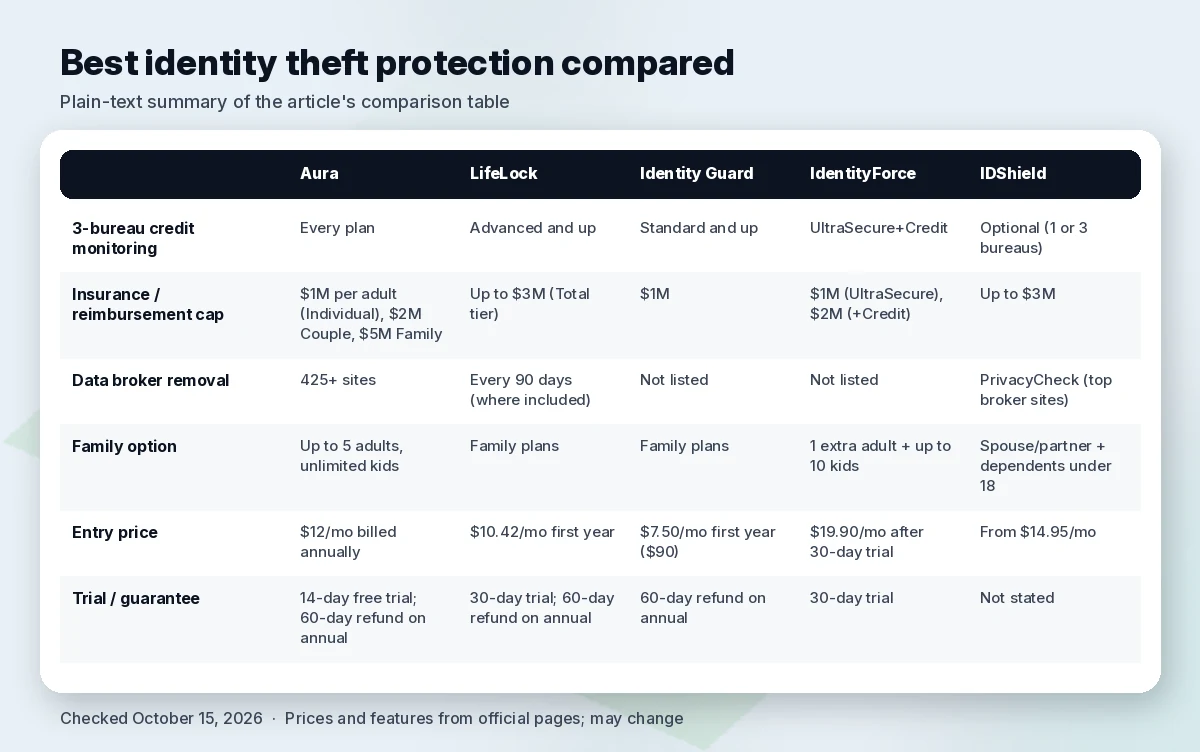
Comparison table
| Aura | LifeLock | Identity Guard | IdentityForce | IDShield | |
|---|---|---|---|---|---|
| 3-bureau credit monitoring | Every plan | Advanced and up | Standard and up | UltraSecure+Credit | Optional (1 or 3 bureaus) |
| Insurance / reimbursement cap | $1M per adult (Individual), $2M Couple, $5M Family | Up to $3M (Total tier) | $1M | $1M (UltraSecure), $2M (+Credit) | Up to $3M |
| Data broker removal | 425+ sites | Every 90 days (where included) | Not listed | Not listed | PrivacyCheck (top broker sites) |
| Family option | Up to 5 adults, unlimited kids | Family plans | Family plans | 1 extra adult + up to 10 kids | Spouse/partner + dependents under 18 |
| Extras | Antivirus, VPN, password manager, spam call protection | Device security bundles | Password manager, safe browsing | VPN for mobile, PC protection | VPN, malware protection, parental controls |
| Entry price (checked Oct 15, 2026) | $12/mo billed annually | $10.42/mo first year | $7.50/mo first year ($90) | $19.90/mo after 30-day trial | From $14.95/mo |
| Trial / guarantee | 14-day free trial; 60-day refund on annual | 30-day trial; 60-day refund on annual | 60-day refund on annual | 30-day trial | Not stated |
Sources linked in each section; checked October 15, 2026. Insurance is issued by third-party insurers and has exclusions; see each provider’s terms.
How we review
We ranked services on: (1) whether 3-bureau credit monitoring is included and on which plans, (2) insurance and reimbursement limits and who issues them, (3) restoration help, (4) family coverage, (5) useful extras such as data broker removal, and (6) price including renewal. Everything comes from each provider’s official pages, checked October 15, 2026, plus the FTC’s consumer guidance. We haven’t run our own monitoring tests or filed claims, so we don’t rate alert speed or claim handling; vendor claims such as “up to 4x faster” alerts are quoted as theirs.
Our picks
1. Aura: best all-in-one
Every Aura plan includes 3-bureau credit monitoring, an instant Experian credit lock, home and auto title monitoring, financial transaction alerts, antivirus, VPN and password manager, data removal from 425+ data brokers and people-search sites plus Google results, and US-based fraud remediation (Aura pricing). Insurance is $1M per adult on Individual, $2M on Couple and $5M on Family, underwritten and administered by American Bankers Insurance Company of Florida, an Assurant company (Summary of Benefits).
Pricing (checked October 15, 2026): Individual $12/mo billed annually (1 adult, 10 devices). Couple $22/mo billed annually or $29 monthly. Family $32/mo billed annually or $50 monthly, covering 5 adults and unlimited kids. 14-day free trial; 60-day money-back guarantee on annual plans (pricing).
Watch out for, including a 2026 incident: in March 2026, Aura disclosed that a phone-phishing attack gave an attacker access to one employee’s account for about an hour. Aura says about 900,000 records were accessed, mostly names and emails from a marketing tool of a company it acquired in 2021, including contact details of fewer than 20,000 active and 15,000 former customers; it says no Social Security numbers, passwords or financial information were compromised and its product databases weren’t accessed (Aura statement). We still rank it first on features and price, but you should know.
2. LifeLock: best for high reimbursement limits
LifeLock (Norton, Gen Digital) sells Core, Advanced and Total, plus Norton 360 bundles. Every plan includes dark web monitoring, breach alerts, financial protection and US-based restoration specialists. Advanced adds 3-bureau credit monitoring, scam protection and alerts on up to five accounts; Total raises stolen funds and personal expense reimbursement to up to $1M, scam reimbursement to up to $10K, covers unlimited accounts and adds 401(k), home title and SIM-swap protection (LifeLock). The top individual figure is “up to $3M” in total coverage. Scam protection benefits are issued by HSB Specialty Insurance Company; for the identity theft coverage, LifeLock says only that insurance benefits are provided by third parties (Summary of Benefits).
Pricing (checked October 15, 2026): individual plans shown from $10.42/mo, $16.67/mo and $29.17/mo for the first year; family plans from $359.99 a year. Prices are introductory and renew at the standard price. 30-day free trial (payment method required); 60-day money-back on annual plans (LifeLock).
Watch out for: 3-bureau monitoring isn’t on Core, and scam reimbursement excludes New York residents. We couldn’t match each displayed price to its plan name on the page, so check the tier at checkout.
3. Identity Guard: best budget pick
Identity Guard’s plans all include $1M identity theft insurance, US-based support, dark web monitoring, data breach notifications, high-risk transaction monitoring, a safe browsing tool and a password manager. Standard adds bank account monitoring and 3-bureau credit monitoring; Ultra adds white-glove fraud resolution and monitoring of social media, cards, 401(k), titles, criminal records and USPS address changes (Identity Guard). The insurance is underwritten and administered by American Bankers Insurance Company of Florida, an Assurant company (Summary of Benefits, hosted by its parent company Aura).
Pricing (checked October 15, 2026): Basic $7.50/mo ($90 first year, renews at $107.88/yr); Standard $16.67/mo ($200.04 first year, renews at $239.88/yr). The page also shows promotional monthly prices (Basic $4.49, Standard $9.99, Ultra $14.99) without stating their terms, so confirm at checkout. 60-day money-back guarantee on annual plans.
Watch out for: Basic has no credit monitoring; for identity theft protection most people need at least Standard.
4. IdentityForce
IdentityForce (TransUnion) offers daily TransUnion credit reports, 24/7 dark web monitoring, a personalized action plan, dedicated restoration specialists and mobile VPN. Its UltraSecure+Credit plan adds 3-bureau monitoring and quarterly 3-bureau reports, with $2M insurance ($1M on UltraSecure); IdentityForce notes that coverage varies in New York and doesn’t name the insurer on its homepage. Family plans add one more adult and up to 10 kids (IdentityForce).
Pricing (checked October 15, 2026): UltraSecure from $19.90/mo after a 30-day trial; UltraSecure+Credit $34.90/mo or $349.90/yr. It’s pricier than the picks above for similar coverage.
5. IDShield
IDShield (Pre-Paid Legal Services) stands out for restoration: a dedicated licensed private investigator handles your case. Plans include dark web monitoring, a choice of 1-bureau or 3-bureau credit monitoring, PrivacyCheck data broker scanning, VPN, malware protection and parental controls, with up to $3M identity fraud protection underwritten and administered through American Bankers Insurance Company of Florida, an Assurant company (IDShield’s homepage doesn’t link a summary of benefits). The family plan covers you, a spouse or partner and dependents under 18 living with you (IDShield).
Pricing (checked October 15, 2026): from $14.95/mo.
What identity theft protection does and doesn’t cover
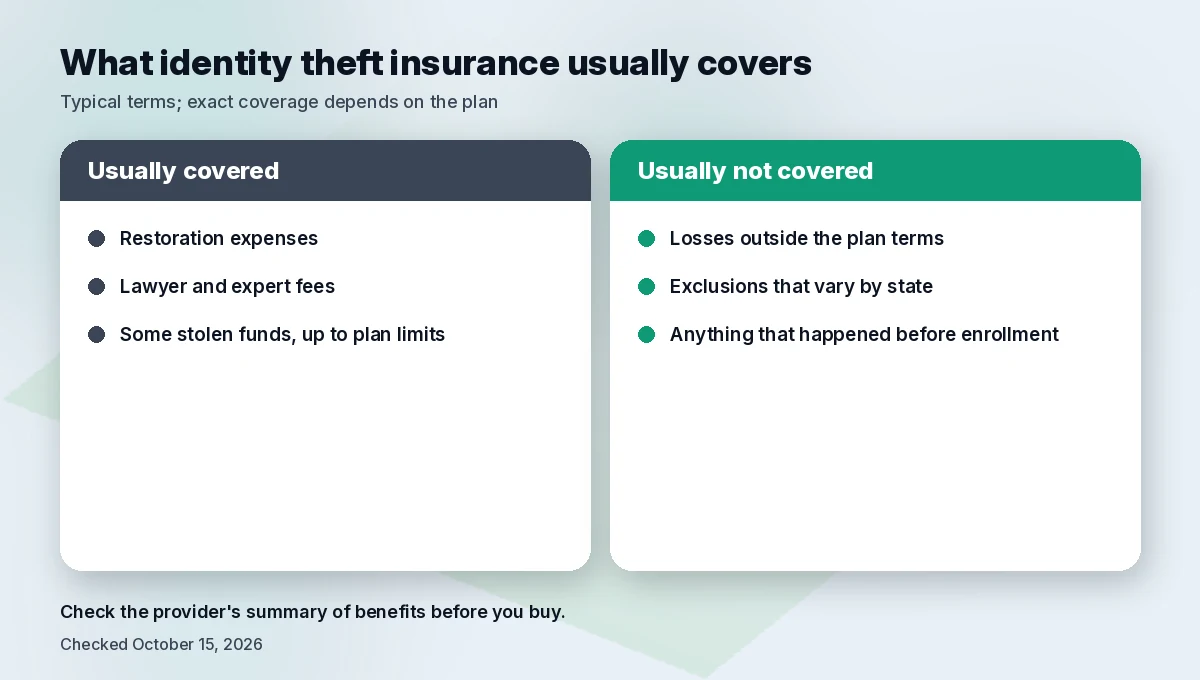
- Monitoring and alerts tell you something happened; they don’t stop it.
- Insurance and reimbursement cover eligible expenses and some stolen funds up to plan limits, under policies issued by third-party insurers with exclusions (LifeLock excludes New York residents from scam protection, and IdentityForce says coverage varies in New York).
- Restoration is the most valuable part when something goes wrong: a specialist working your case with banks, bureaus and agencies.
- No service prevents all identity theft. LifeLock says so in its own fine print.
Free steps first: credit freeze, fraud alert, IdentityTheft.gov
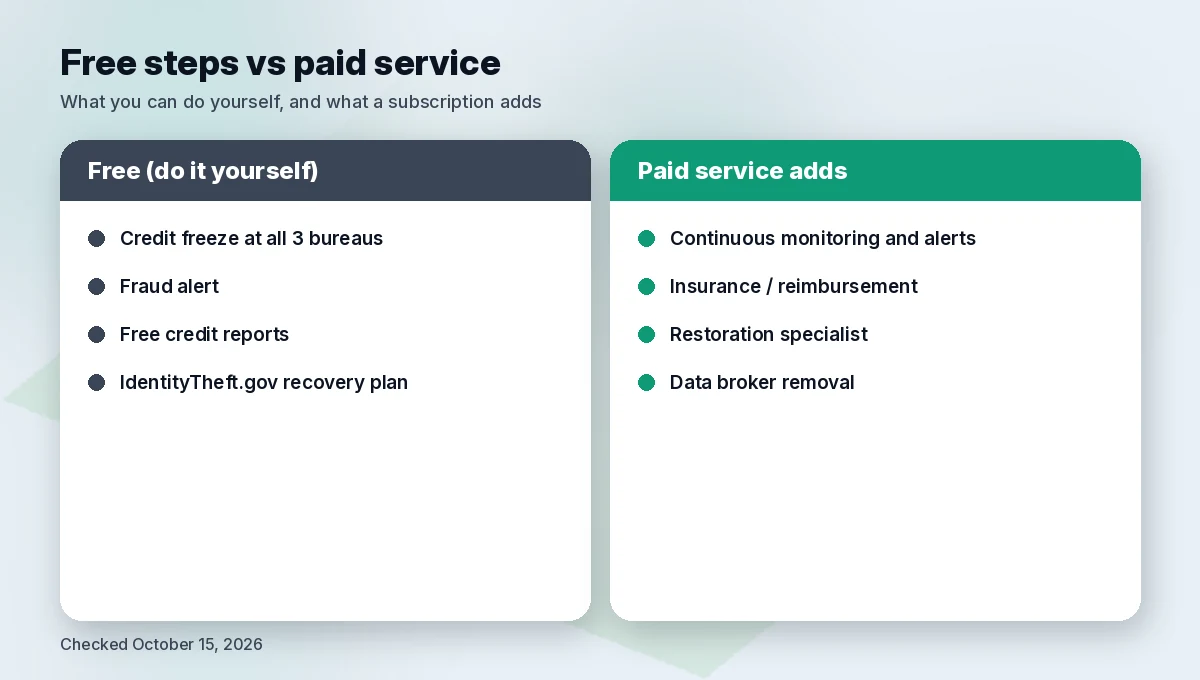
- Freeze your credit at Equifax, Experian and TransUnion. It’s free, lasts until you lift it, and you can lift it temporarily when you apply for credit (FTC).
- Freeze your kids’ credit if they’re under 16; the FTC explains the separate process.
- Place a fraud alert if you suspect identity theft: contact one bureau and it must notify the other two. An initial alert lasts one year; an extended alert, for confirmed victims, lasts seven.
- Check your credit reports for accounts you don’t recognize.
- If it happens, report it at IdentityTheft.gov for a recovery plan.
If you do all of that, the main reasons to pay are continuous monitoring, insurance and a restoration specialist.
Beyond identity monitoring
Two tools that reduce your exposure (not part of the ranking): a data removal service to take your details off people-search sites, and a password manager for unique passwords.
FAQ
Is identity theft protection worth it? It’s worth it if you want monitoring, insurance and restoration help without doing it yourself. Start with a free credit freeze either way.
What is the best identity theft protection for seniors? Look for restoration help and simple alerts: IDShield’s licensed investigators and Aura’s Trusted Family Access (on Couple and Family plans) are worth a look.
Is Aura better than LifeLock? For features per dollar, Aura: 3-bureau monitoring and data removal on every plan. LifeLock offers higher reimbursement limits on its top tier.
How much does identity theft protection cost? Roughly $7.50 to $35 a month for one person among the services above, before renewal increases.
Can I protect myself from identity theft for free? Partly: freeze your credit, use fraud alerts, check your reports and use IdentityTheft.gov if needed. You don’t get insurance or a restoration specialist.
Does identity theft insurance cover stolen money? Some plans reimburse stolen funds up to a limit (LifeLock Total up to $1M, for example), subject to policy terms and exclusions.
Verdict
Aura is the best identity theft protection for most people: 3-bureau monitoring, data broker removal and device security on every plan, with a strong family plan, despite its March 2026 marketing-data incident. Pick LifeLock for the highest reimbursement limits, or Identity Guard Standard on a budget. Freeze your credit first, whatever you choose.
Sources (official pages, checked on October 15, 2026)
- Aura pricing: https://www.aura.com/pricing
- Aura statement on the March 2026 incident: https://www.aura.com/press/release/statement-on-exposure-of-customer-information
- LifeLock plans: https://lifelock.norton.com/products
- Identity Guard: https://www.identityguard.com/
- IdentityForce: https://www.identityforce.com/
- IDShield: https://www.idshield.com/
- FTC, Credit Freezes and Fraud Alerts: https://consumer.ftc.gov/articles/what-know-about-credit-freezes-fraud-alerts
- IdentityTheft.gov: https://www.identitytheft.gov/