

Affiliate disclosure: VPN Vetted is reader-supported. Some links below are affiliate links (marked “sponsored”): if you buy through them we may earn a commission at no extra cost to you. We recommend by published price, refund terms and audits, never by commission. Private Internet Access (PIA) is owned by Kape Technologies, which also owns ExpressVPN and CyberGhost. NordVPN and Surfshark, our alternatives below, both belong to Nord Security (the companies merged in 2022). We hold all of them to the same criteria.
Prices checked October 31, 2026, between 01:08 and 01:11 BRT, on the official US pages, in USD, before sales tax or VAT.
Verdict in 30 seconds
- Buy PIA if you want one subscription for every device in the house and a long plan with a published renewal price. The 3-year plan is shown at $2.03 a month for 3 years + 3 extra months, and it renews at $79 every 3 years. PIA allows unlimited devices at once.
- Skip it if you want a VPN company based outside the US, or a recent, dated no-logs audit report you can read on the provider’s own site.
- Compare first if you’d rather have a bigger security bundle (NordVPN) or unlimited devices at a lower 27-month price (Surfshark).
Our opinion: on published US prices, PIA’s 3-year plan is one of the cheapest long-term VPN bills we track, because the renewal ($79 per 3 years) is printed right on the checkout page. The trade-offs are US jurisdiction and audit details that PIA summarises rather than dates.
What PIA offers in 2026
Private Internet Access is a US VPN company: its about page gives the address as PIA Private Internet Access, Inc., Denver, Colorado. Kape Technologies lists PIA as one of its top brands, next to ExpressVPN, CyberGhost and Intego, and PIA’s privacy policy refers to “PIA” and “anyone at Kape Technologies” in its no-logging commitment.
PIA sells one VPN plan in three lengths. The checkout page also offers two add-ons, Dedicated IP and Antivirus (PIA says the antivirus checks Windows devices), selected in the order details at checkout; the plan cards don’t show their prices.
The features page lists apps for Windows, macOS, Linux, Android, iOS, Chrome and Firefox, plus Android TV, Apple TV and router setups, and says the network has 180 locations in 113 countries.
PIA pricing: intro vs renewal
Here is what PIA’s US checkout page (privateinternetaccess.com/buy-vpn) showed on October 31, 2026:
| Plan | Price shown | First bill | Renews at |
|---|---|---|---|
| 1 month | $11.95/mo | $11.95 | $11.95 every month |
| 1 year | $3.99/mo | $47.88 | $47.88 a year |
| 3 years + 3 months | $2.03/mo | not shown as a total (about $79 by our arithmetic) | $79 every 3 years |
The page says “All amounts are shown in USD” and that discounts are measured against the $11.95 monthly price. It carried a “Halloween Price Slash” banner on October 31, 2026, so these figures may change after the holiday sales.
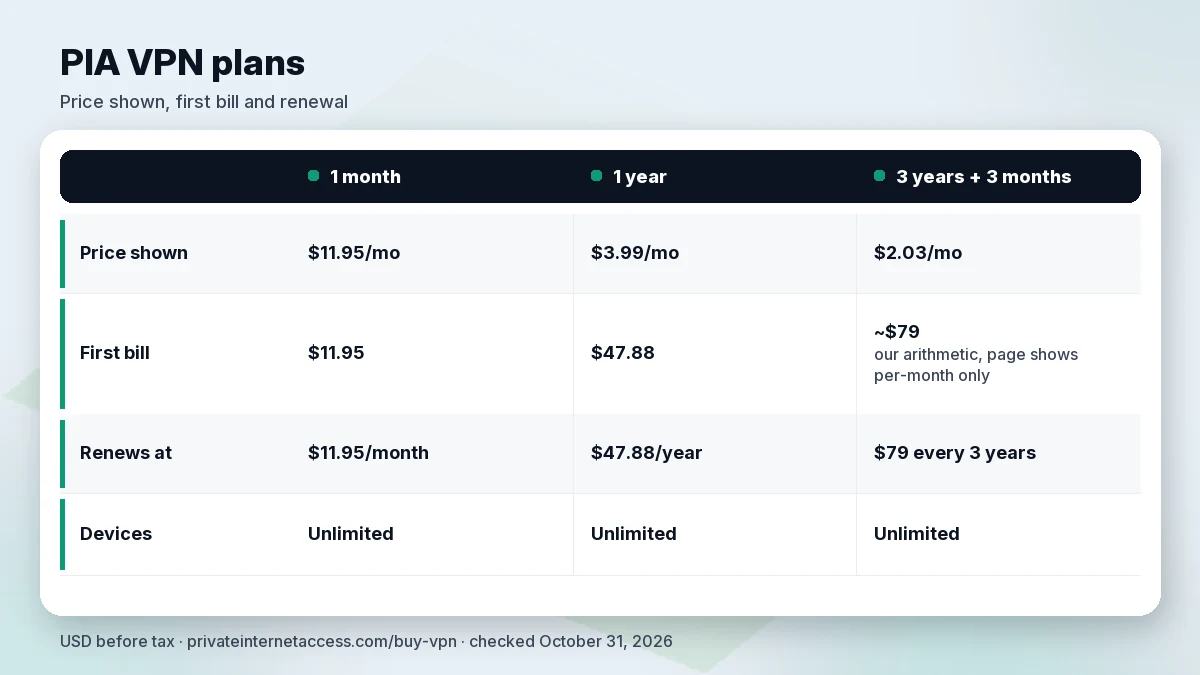
Why renewal matters (our arithmetic, before tax): the 3-year plan’s 39 months at $2.03 come to about $79.17, and after that PIA charges $79 for each further 3 years, roughly $26.33 a year. The 1-year plan costs $47.88 every year, intro and renewal alike. Many VPNs publish a low first term and a higher renewal; PIA’s long plan doesn’t jump much, which is the main reason it does well on long-term cost.
PIA’s terms add that it “reserves the right to change the fees at any time” with advance notice, and that fee changes apply at the next renewal. Check the renewal reminder email before you’re charged.
Unlimited devices
PIA’s checkout page promises “Unlimited Device Security”: you can connect an unlimited number of devices at once on one subscription. For a household with phones, laptops, tablets and a TV, that removes the device-count question. NordVPN caps a paid account at 10 devices; Surfshark is also unlimited.
There is a fair-use limit in the terms: PIA can contact you, and then “limit or restrict your usage”, if it sees abuse of the unlimited simultaneous devices provision (its examples are resale and non-personal use). For one family’s own devices, that shouldn’t apply. See our best VPN for multiple devices guide for other options.
30-day money-back guarantee
PIA offers a 30-day money-back guarantee, but its pages describe it in two ways:
- The checkout and money-back pages say it is “available to new subscribers only”, and that app-store purchases follow the store’s refund terms.
- The terms of service (last updated September 24, 2026) say PIA will refund a payment requested “within thirty (30) days from the date of the initial purchase and/or renewal”.
The terms also say you won’t get a refund on a new account bought within 3 months of a previous refund. Accounts bought through the Apple App Store, Google Play, gift cards or third-party deal sites can only be refunded by that seller. If you plan to rely on a refund after a renewal, ask support to confirm it in writing first.
Cancellation
The terms say you can cancel at any time: log in to your PIA account, open “Subscriptions” and follow the prompts to turn off auto-renewal. If you’re outside the refund window, the account stays active until the end of the period you paid for. The terms say subscriptions renew automatically unless cancelled at least 24 hours before the current period ends; app-store subscriptions are cancelled in the store.
Privacy, audits and jurisdiction
No-logs policy. PIA’s features page says your “browsing activity is your business” and that it “doesn’t collect or store your browsing data”. Its no-logs page says the servers are RAM-only and that the policy has been “confirmed in court and independently audited by Deloitte”. The same page names Deloitte Audit Romania as the auditor. We couldn’t find a date for that audit on PIA’s own pages, so we can’t tell you how recent it is.
Court record. PIA’s transparency page says it was subpoenaed for user activity logs in 2016 and 2017 and could not provide any. It also says PIA has had two third-party audits in total.
Transparency report. PIA publishes quarterly figures. The latest on the page (Q2 2026, April 1 to June 30, 2026) lists 4 subpoenas, 2 warrants, 7 other government or civil requests and 6 foreign or informal requests, with 0 logs produced for each.
Open source. PIA’s privacy policy calls its applications and clients “100% open-source” and links to its public code on GitHub (github.com/pia-foss).
Jurisdiction. PIA is a US company and its terms are governed by Colorado law. Some readers prefer a provider based outside the US; PIA’s position is that every VPN must answer legal requests in its own country, and that it has no activity logs to hand over. Whether that is enough is your call. Our opinion: the court record and quarterly reports carry more weight than the country alone, but a dated, downloadable audit would make PIA’s case stronger.
Ownership. Kape Technologies owns PIA, ExpressVPN and CyberGhost. If you’re comparing those three, you’re comparing brands from the same group.
Key features
These are the features PIA documents on its own features and money-back pages. We describe them as PIA does; we didn’t run our own checks.
- WireGuard and OpenVPN. Both open-source protocols. PIA says its WireGuard connection uses ChaCha20 encryption.
- MACE. A DNS-based blocker for ads, trackers and malware domains.
- Advanced Kill Switch. Blocks internet traffic whenever the VPN isn’t connected, even if you disconnect yourself.
- Split tunneling. Lets chosen apps or websites use your normal connection.
- Multi-Hop and obfuscation. Multi-Hop routes traffic through an additional server; obfuscation adds a layer of SSL encryption so VPN traffic looks like regular web traffic on your network.
- DNS leak protection and Smart Automation, which lets you set connection rules by network type so the VPN turns on without you doing it by hand.
- Identity Guard. Alerts you if your email address shows up in a known breach.
If public Wi-Fi is your main reason for a VPN, our best VPN for public Wi-Fi guide covers what matters there.
Pros and cons
Pros
- Published renewal prices on every plan, with a low one on the 3-year plan ($79 per 3 years)
- Unlimited devices on one subscription
- Open-source apps and clients
- RAM-only servers, a court record from 2016 and 2017, and quarterly transparency reports
- WireGuard, MACE, kill switch and split tunneling in the standard plan
- 30-day money-back guarantee
Cons
- US-based, which some privacy-focused buyers rule out
- Deloitte audit named but not dated on PIA’s own pages
- Refund rules differ between the checkout page and the terms
- Dedicated IP and Antivirus are paid add-ons with no price shown up front
- Owned by Kape Technologies, so PIA, ExpressVPN and CyberGhost aren’t independent rivals
Who should buy PIA
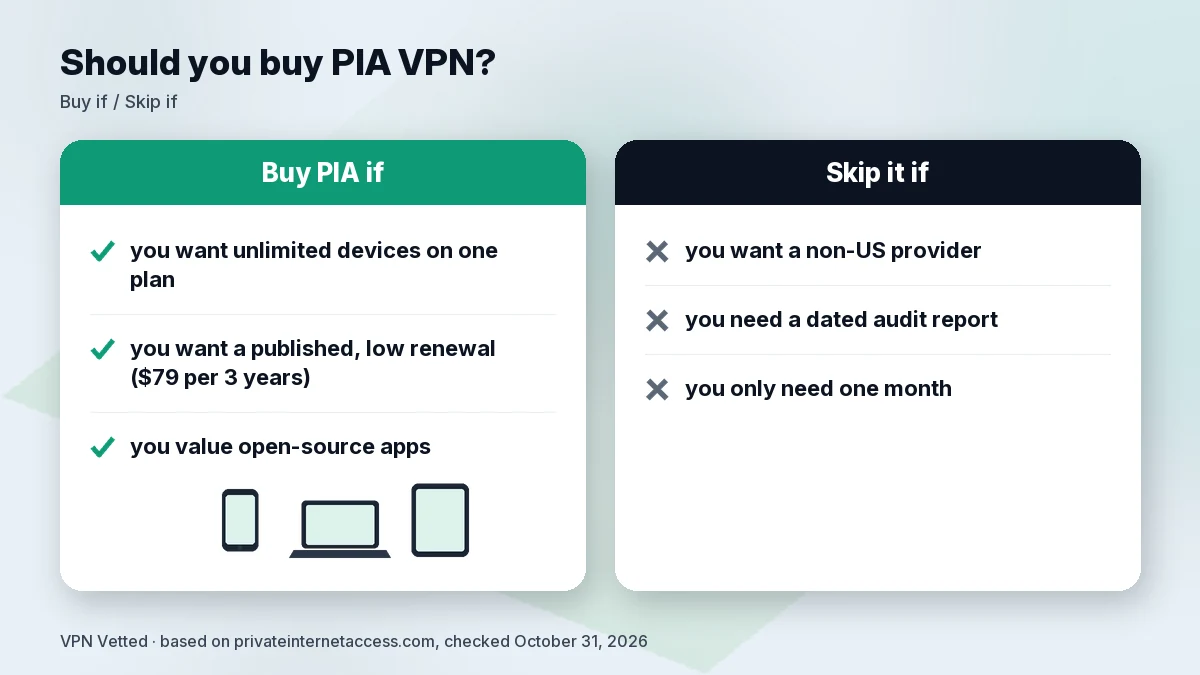
Buy PIA if:
- You want one of the lowest long-term bills among the VPNs compared here, renewal included
- You have more devices than a 10-device cap allows
- You value open-source apps and a public transparency report
- You’ll commit to 3 years
Skip PIA if:
- You want a VPN company based outside the US
- You want a freshly dated audit report before you buy
- You only need a VPN for a month (PIA’s monthly plan is $11.95)
- You want antivirus or identity tools bundled in the base price (see NordVPN below)
PIA alternatives
NordVPN (bigger security bundle, 10 devices)
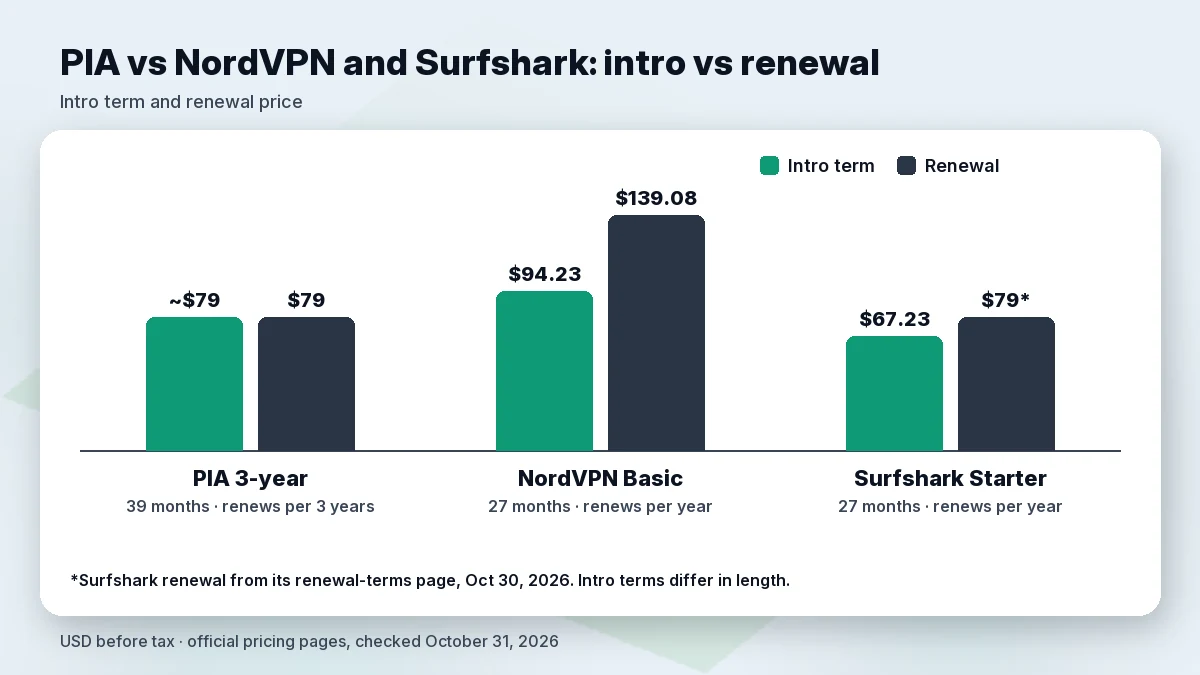
NordVPN’s US pricing page lists Basic at $3.49 a month, $94.23 for the first 27 months, renewing at $139.08 a year, with 10 devices and a 30-day money-back guarantee. Its Complete plan adds anti-malware, an ad and tracker blocker and a password manager. The page carries a Black Friday banner today. NordVPN costs more than PIA after the first term, but bundles more security tools. Read is NordVPN worth it and NordVPN vs Surfshark.
Surfshark (unlimited devices, same owner as NordVPN)
Surfshark’s US pricing page lists Starter at $2.49 a month, $67.23 for the first 27 months, under a “Black Friday deal” label, with unlimited devices and a 30-day money-back guarantee. Its renewal-terms page showed Starter renewing at $79 a year when we checked on October 30, 2026 (renewal figure from our October 30 capture, not rechecked on October 31). Compared with PIA: Surfshark’s upfront bill for 27 months ($67.23) is lower than PIA’s 3-year arithmetic (~$79), but PIA’s monthly rate ($2.03) is lower than Surfshark’s ($2.49), and PIA’s printed renewal ($79 every 3 years) undercuts Surfshark’s yearly renewal after the intro. See our Surfshark review.
On a tight budget? Our best cheap VPN roundup compares more renewal prices, and our best free VPN guide covers the free options and their limits.
How we evaluated
We read PIA’s US checkout page, its features, no-logs, money-back, about and transparency-report pages, its terms of service and its privacy policy, and Kape Technologies’ brands page. For the alternatives we read the NordVPN and Surfshark US pricing pages. We recorded the date and time of each check in BRT and saved copies. We did not run our own speed, leak or hands-on tests, so nothing here claims that. Where PIA’s pages disagree, we quote both.
FAQ
Is PIA VPN worth it in 2026?
For households with many devices who will commit to 3 years, yes, in our opinion. The 3-year plan is $2.03 a month for 39 months and renews at $79 every 3 years, with unlimited devices. If US jurisdiction or the undated audit bothers you, look at the alternatives.
How much does PIA cost after the first term?
PIA’s checkout page lists the renewals: $79 every 3 years on the 3-year plan, $47.88 a year on the 1-year plan and $11.95 a month on the monthly plan, all in USD before tax (checked October 31, 2026).
How many devices can I use with PIA?
Unlimited devices at the same time on one subscription. PIA’s terms let it restrict accounts it believes are abusing this, for example through resale.
Does PIA have a money-back guarantee?
Yes, 30 days. The checkout page says it is for new subscribers only; the terms mention refunds within 30 days of an initial purchase or renewal. App-store purchases are refunded by the store.
Is PIA safe even though it’s based in the US?
PIA says it keeps no activity logs, runs RAM-only servers, publishes quarterly transparency reports (0 logs produced in Q2 2026) and was unable to hand over logs when subpoenaed in 2016 and 2017. It also names a Deloitte audit, though without a date on its own pages. Whether US jurisdiction is acceptable depends on your threat model.
PIA vs NordVPN vs Surfshark: which should I pick?
Among the VPNs compared here, PIA has a low published long-term price on its 3-year plan and unlimited devices. Surfshark’s 27-month intro bill is lower up front ($67.23 vs about $79) and it is also unlimited; PIA’s monthly rate and printed 3-year renewal are lower. NordVPN costs the most at renewal but includes more security tools in its higher plans. NordVPN and Surfshark share an owner (Nord Security); PIA belongs to Kape.
How do I cancel PIA?
Log in to your PIA account, open “Subscriptions” and turn off auto-renewal. Your access continues until the paid period ends. Ask for a refund within 30 days if you’re eligible; app-store subscriptions are cancelled in the store.
Bottom line
PIA is a strong value pick in 2026 for one reason above all: a low, published renewal price ($79 every 3 years) with unlimited devices. It adds open-source apps, RAM-only servers and a public transparency record. The trade-offs are US jurisdiction, an undated audit on its own pages and refund wording that varies by page. If those are acceptable, the 3-year plan is the one to look at, and put the renewal date in your calendar.
Sources (official pages, checked on October 31, 2026)
- PIA, checkout and pricing (USD): https://www.privateinternetaccess.com/buy-vpn (~01:08 BRT)
- PIA, VPN features: https://www.privateinternetaccess.com/vpn-features (~01:10 BRT)
- PIA, no-logs policy (Deloitte, RAM-only): https://www.privateinternetaccess.com/vpn-features/no-logs-vpn (~01:11 BRT)
- PIA, transparency report (Q2 2026): https://www.privateinternetaccess.com/transparency-report (~01:11 BRT)
- PIA, money-back guarantee: https://www.privateinternetaccess.com/money-back-guarantee (~01:11 BRT)
- PIA, terms of service (last updated September 24, 2026): https://www.privateinternetaccess.com/pages/terms-of-service (~01:10 BRT)
- PIA, privacy policy (last revised November 3, 2025): https://www.privateinternetaccess.com/pages/privacy-policy (~01:10 BRT)
- PIA, about us: https://www.privateinternetaccess.com/about-us (~01:10 BRT)
- Kape Technologies, our brands: https://www.kape.com/our-brands/ (~01:11 BRT)
- NordVPN, pricing (US/USD): https://nordvpn.com/pricing/ (~01:11 BRT)
- Surfshark, pricing (US/USD): https://surfshark.com/pricing (~01:11 BRT)
- Surfshark, renewal prices (checked October 30, 2026): https://surfshark.com/terms-of-service/pricing