
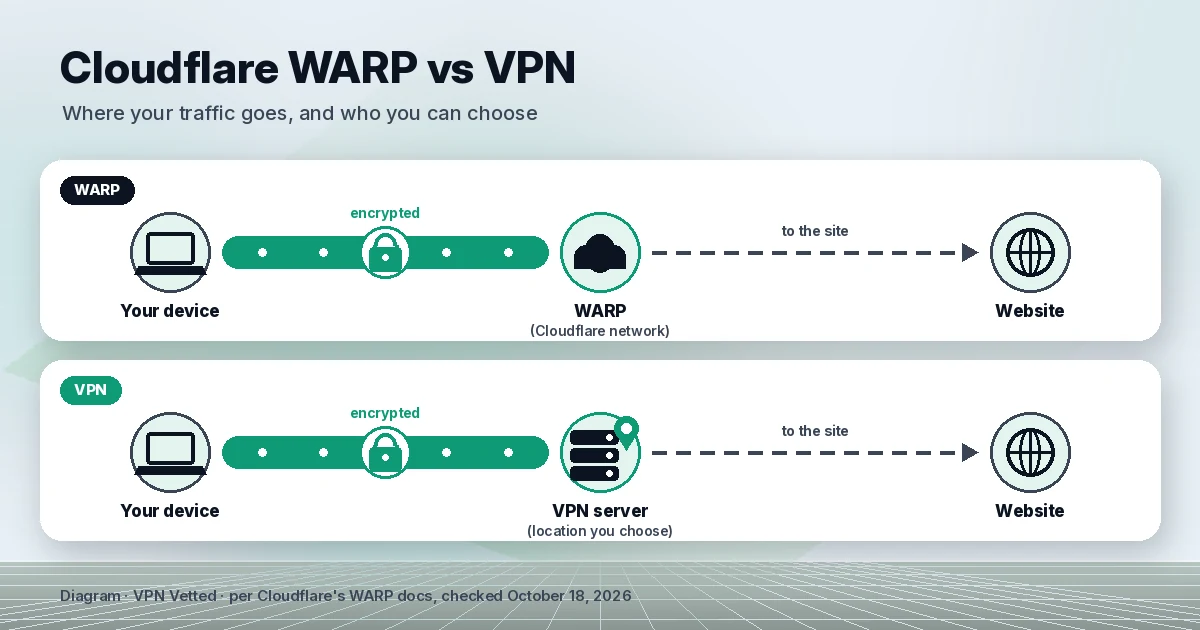
WARP encrypts the traffic between your device and Cloudflare’s network, and websites see a Cloudflare IP address instead of yours. But Cloudflare says plainly that WARP is “not designed to prevent servers you communicate with from identifying you,” and it gives you an IP for the country you connect from. A no-logs VPN with a published audit makes more sense when you want to choose your server and verify the logging claims.
Affiliate disclosure: VPN Vetted is reader-supported. Some links below are affiliate links (marked “sponsored”): if you buy through them we may earn a commission at no extra cost to you. Cloudflare WARP has no affiliate link here. Surfshark and NordVPN both belong to Nord Security; we hold them to the same criteria as Proton VPN.
Cloudflare’s WARP docs and privacy policy checked October 18, 2026. VPN prices checked October 18, 2026, on the official US pages, in USD.
Short version: for free encryption on café or hotel Wi-Fi, WARP works. For a free option with a published no-logs audit, look at Proton VPN’s free plan. Check Proton VPN price
What Cloudflare WARP is (and isn’t)
WARP is the free app Cloudflare also calls “1.1.1.1 with WARP.” Its docs say the client “sits between your device and the Internet, and has several connection modes.” The WARP modes page (last updated October 12, 2026) describes them:
- Traffic and DNS (the full WARP service): the app “uses MASQUE to encrypt and send traffic from your device directly to Cloudflare’s global network,” and traffic in that tunnel is encrypted with post-quantum cryptography, per Cloudflare.
- DNS only: routes only DNS queries through the 1.1.1.1 resolver and “does not tunnel device traffic.”
- Traffic only and Local proxy (desktop only, just the apps you configure) are the other two.
Cloudflare’s own caution note says WARP “is not designed to prevent servers you communicate with from identifying you,” and that it “does not allow you to pretend to be accessing the Internet from a different country.”
So WARP is an encrypted tunnel to Cloudflare’s network. It does part of a VPN’s job, but it doesn’t let you pick where your traffic exits.
WARP vs VPN at a glance
| Cloudflare WARP (free) | NordVPN | Surfshark | Proton VPN | |
|---|---|---|---|---|
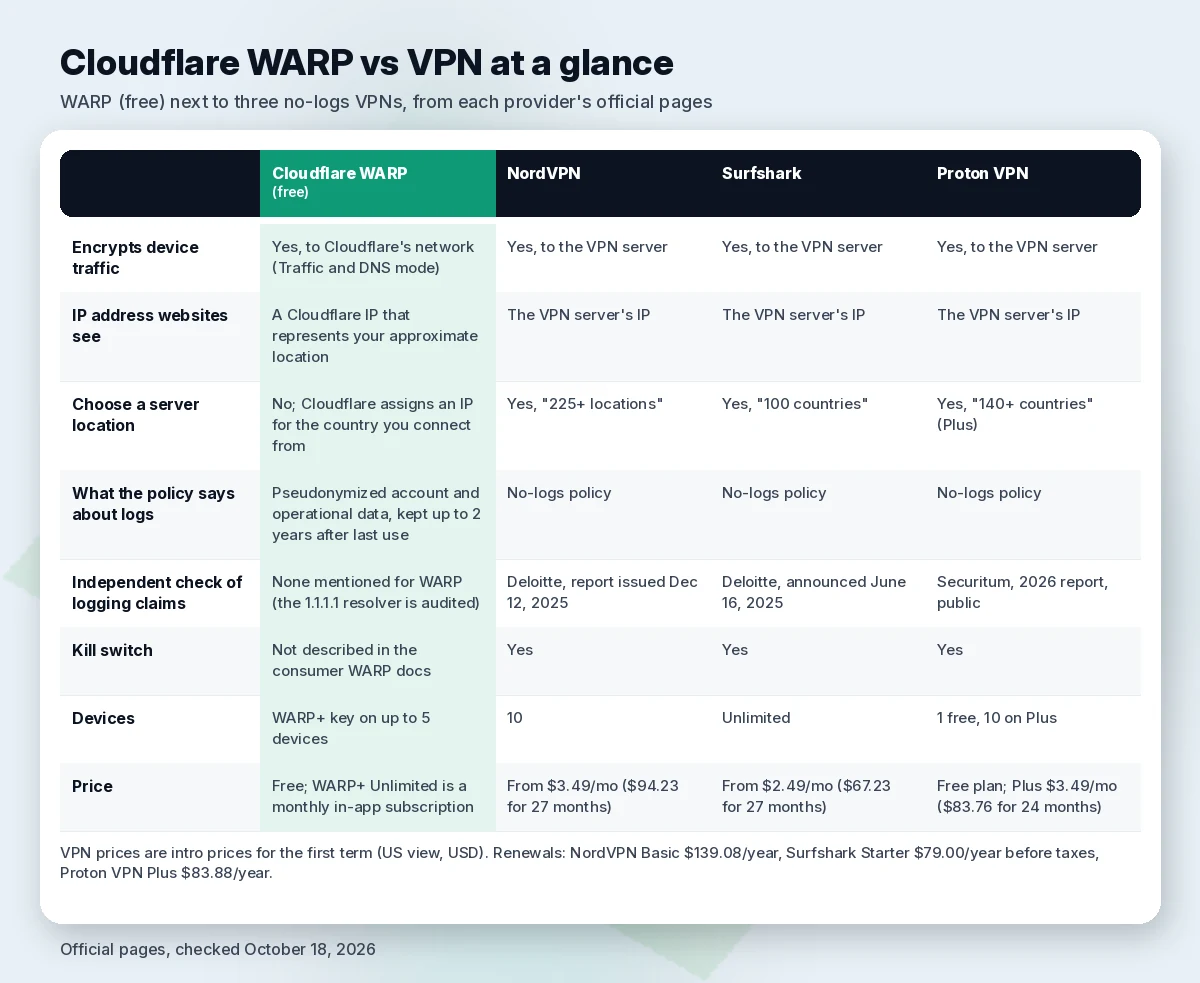
| Encrypts device traffic | Yes, to Cloudflare’s network (Traffic and DNS mode) | Yes, to the VPN server | Yes, to the VPN server | Yes, to the VPN server |
| IP address websites see | A Cloudflare IP that represents your approximate location | The VPN server’s IP | The VPN server’s IP | The VPN server’s IP |
| Choose a server location | No; Cloudflare assigns an IP for the country you connect from | Yes, “225+ locations” | Yes, “100 countries” | Yes, “140+ countries” (Plus) |
| What the policy says about logs | Pseudonymized account and operational data, kept up to 2 years after last use | No-logs policy | No-logs policy | No-logs policy |
| Independent check of logging claims | None mentioned for WARP (the 1.1.1.1 resolver is audited) | Deloitte, report issued Dec 12, 2025 | Deloitte, announced June 16, 2025 | Securitum, 2026 report, public |
| Kill switch | Not described in the consumer WARP docs | Yes | Yes | Yes |
| Devices | Free app: no limit stated; a WARP+ key works on up to 5 devices | 10 | Unlimited | 1 free, 10 on Plus |
| Price | Free; WARP+ Unlimited is a monthly in-app subscription | From $3.49/mo ($94.23 for 27 months) | From $2.49/mo ($67.23 for 27 months) | Free plan; Plus $3.49/mo ($83.76 for 24 months) |
| Link | Cloudflare 1.1.1.1 | Check NordVPN price | Check Surfshark price | Check Proton VPN price |
Sources: Cloudflare WARP docs, FAQ and Application Privacy Policy; NordVPN, Surfshark and Proton VPN pricing, audit and kill switch pages; all checked October 18, 2026. VPN prices are intro prices for the first term (US view, USD); renewals: NordVPN Basic $139.08/year, Surfshark Starter $79.00/year before taxes, Proton VPN Plus $83.88/year.
Does WARP hide your IP address?
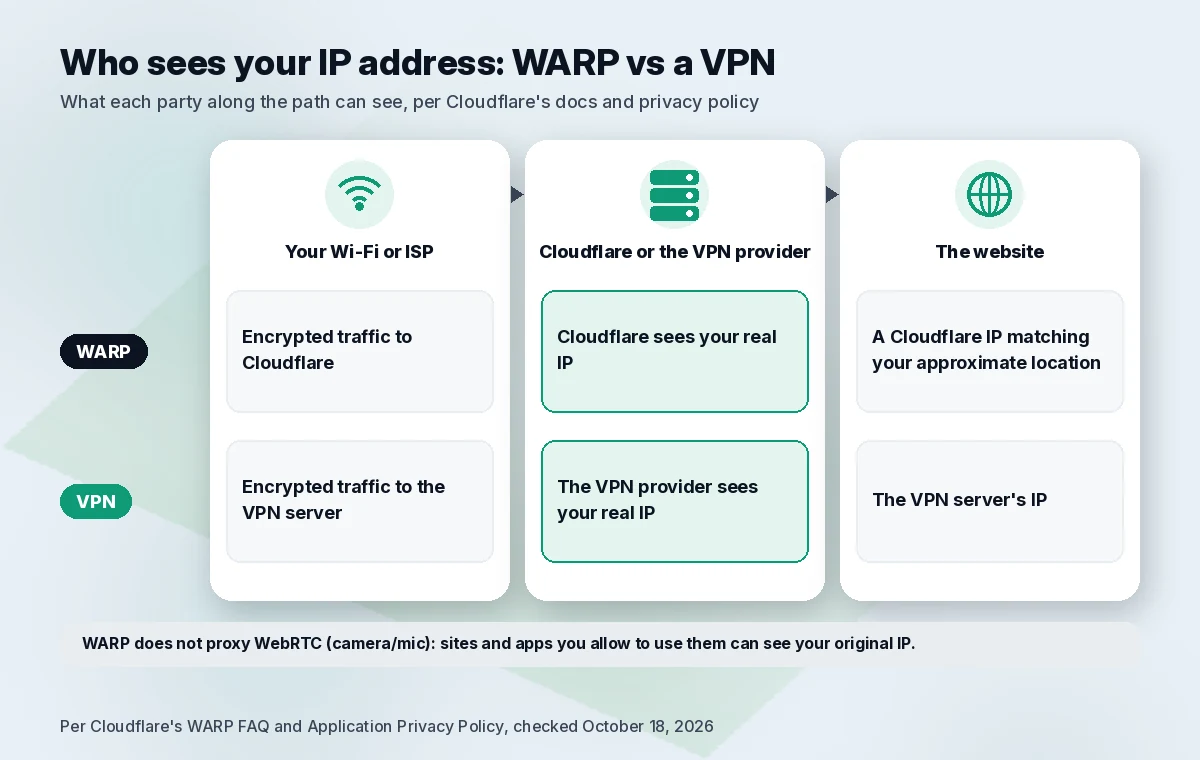
From websites, mostly yes. Cloudflare’s WARP FAQ answers “Does WARP reveal my IP address to websites I visit?” with “No,” and says WARP “replaces your original IP address with a Cloudflare IP that consistently and accurately represents your approximate location,” whether or not the site uses Cloudflare.
There are three limits worth knowing:
- Cloudflare sees your real IP. Its privacy policy says: “When you connect to our network, we see your IP address and use it to assign you a Cloudflare IP address corresponding to the country in which you are connecting from.”
- Camera and microphone traffic is excluded. Cloudflare says WARP “does not proxy WebRTC traffic,” so sites and apps you allow to use your camera or microphone, such as video calls, can see your original IP.
- Your approximate location still shows. That is by design: the IP websites see is meant to match your area.
With a VPN, the website sees the IP of the VPN server you picked, and the VPN provider is the one that sees your real IP. That’s why its logging record matters.
What Cloudflare logs vs a no-logs VPN
Cloudflare’s Application Privacy Policy (last updated April 24, 2025) covers the consumer WARP app. It lists three kinds of data:
- Account data, such as your account ID, subscription and referral details.
- Operational data: request data (source IP, source port, destination IP), performance data (“the services you have enabled and the amount of data you have transferred”), device model and operating system, crash logs and connection data.
- DNS resolver information: “The DNS query data that we retain does not contain your IP addresses or personal information, and the bulk of the data is only stored for 24 hours.”
The key sentences: account and operational data “are pseudonymized,” Cloudflare says “We do not retain a link between the IP address you use to access the Internet via our Application and the websites you visit,” and “Your Account Data and Operational Data will be stored for no longer than two years after your last use of the Application.” Cloudflare also says it “will not sell or rent your personal information to anyone,” and that it may disclose information in response to “subpoenas, court orders, or legal process.” (WARP used through an employer’s Zero Trust account falls under a different policy.)
On audits, Cloudflare says it hired “one of the top four accounting firms” to audit the privacy commitments of its 1.1.1.1 public DNS resolver. Neither the WARP docs nor the Application Privacy Policy mentions an audit of WARP itself.
The three VPNs below make a narrower promise, a no-logs policy, and each points to an outside check:
- NordVPN: Deloitte Lithuania ran an ISAE 3000 (Revised) assurance engagement from November 10 to December 12, 2025, and issued its report on December 12, 2025, NordVPN’s sixth. Users can read it after logging in to their Nord Account.
- Surfshark: Deloitte verified its no-logs policy again, Surfshark announced on June 16, 2025. The ISAE 3000 report is in the Surfshark account.
- Proton VPN: Securitum’s 2026 audit was Proton’s fifth consecutive annual no-logs audit, and Proton publishes the full reports for anyone to read.
The difference: WARP’s policy lists what Cloudflare keeps and for how long, while these VPNs claim to keep no activity logs and name an outside firm that checked.
When WARP is enough, and when you want a VPN
WARP is likely enough if:
- you mainly want encryption on public Wi-Fi so the local network can’t read your traffic (Cloudflare says WARP “prevents anyone from snooping on you by encrypting more of the traffic leaving your device”);
- you’re fine with Cloudflare seeing your IP under the policy above and don’t need to pick a server.
A VPN fits better if:
- you want to choose the server your traffic leaves from;
- you want a no-logs claim backed by a named outside firm;
- you want a documented kill switch, which all three VPNs below list;
- you’re covering a household: Surfshark allows unlimited devices, and NordVPN and Proton VPN Plus allow 10.
For hotel and airport networks specifically, see our best VPN for public Wi-Fi guide. For the legal side, see our guide to whether using a VPN is legal in the US.
VPNs worth considering instead
Listed by price, not ranked.
Proton VPN
The closest match to WARP’s price, because there’s a free plan: one device, “Medium VPN speed,” servers in 10 randomly selected countries. VPN Plus is $3.49 a month ($83.76 for 24 months, then $83.88 a year) on the pricing page, with a 30-day money-back guarantee. Read our Proton VPN review.
- Pros: free plan; “100% open source” apps; kill switch; no-logs audits published in full.
- Cons: the free plan covers one device and picks the countries for you; Plus is billed for 24 months upfront.
Surfshark
Starter is $2.49 a month, $67.23 for 27 months, then $79.00 a year before taxes. Surfshark and NordVPN share an owner, Nord Security. See NordVPN vs Surfshark.
- Pros: the lowest intro price here; unlimited simultaneous devices; a Deloitte no-logs audit; a “soft” or “strict” kill switch on iOS, macOS, Android, Windows and Linux.
- Cons: tax is added at checkout; the 2-year plan then renews every year at the full price.
NordVPN
Basic is $3.49 a month ($94.23 for 27 months, then $139.08 a year), covers 10 devices and has a 30-day refund window.
- Pros: six no-logs assurance engagements, the latest by Deloitte in December 2025; a kill switch on Windows, Android and Linux, and a similar always-on protection on iOS and the App Store version for macOS.
- Cons: the highest renewal price of the three; the audit report is only readable after logging in to a Nord Account.
On a budget? Our best cheap VPN guide and VPN Black Friday deals page track current prices.
How we evaluated
We read Cloudflare’s own WARP docs, FAQ, Application Privacy Policy and 1.1.1.1 resolver privacy page, plus the official pricing, audit and kill switch pages of NordVPN, Surfshark and Proton VPN (US view, USD), all on October 18, 2026. We did not run our own speed, IP or leak tests and don’t claim any. This is general information, not legal advice.
FAQ
Is Cloudflare WARP a real VPN?
Partly. It’s an encrypted tunnel from your device to Cloudflare’s network, but Cloudflare says it isn’t designed to stop servers from identifying you and doesn’t let you choose another country.
Does Cloudflare WARP hide my IP from websites?
Yes, with limits. Websites see a Cloudflare IP that matches your approximate location, Cloudflare sees your real IP, and WebRTC traffic isn’t sent through WARP.
Does Cloudflare log WARP traffic?
Cloudflare says it doesn’t keep a link between your IP and the websites you visit. It does keep pseudonymized account and operational data for up to two years after your last use, and DNS data without IP addresses, mostly for 24 hours.
Is WARP+ worth paying for?
Cloudflare describes WARP+ Unlimited as “a larger network” that “can reduce latency.” The docs list no extra privacy features. It’s sold monthly through the App Store or Google Play, priced in the app.
Is WARP safe on public Wi-Fi?
In Traffic and DNS mode, WARP encrypts traffic between your device and Cloudflare, so the local network sees an encrypted connection to Cloudflare. DNS only mode doesn’t tunnel traffic.
Verdict
WARP is a solid free privacy layer from a company that publishes exactly what it keeps. It isn’t built to stop websites or Cloudflare from knowing roughly where you are, and we found no audit specific to WARP. If you want a free option with a published no-logs audit, start with Proton VPN’s free plan. If you need more devices or server choice, NordVPN, Surfshark and Proton VPN Plus all cost under $4 a month on their current intro prices.
Check Proton VPN price · Check Surfshark price · Check NordVPN price
Sources (official pages, checked October 18, 2026)
- Cloudflare, WARP client overview (last updated Apr 17, 2026): https://developers.cloudflare.com/warp-client/
- Cloudflare, WARP modes (last updated Oct 12, 2026): https://developers.cloudflare.com/warp-client/warp-modes/
- Cloudflare, WARP client FAQ (last updated Apr 17, 2026): https://developers.cloudflare.com/warp-client/known-issues-and-faq/
- Cloudflare, Application Privacy Policy (last updated April 24, 2025): https://www.cloudflare.com/application/privacypolicy/
- Cloudflare, 1.1.1.1 Public DNS Resolver privacy: https://developers.cloudflare.com/1.1.1.1/privacy/public-dns-resolver/
- Cloudflare, 1.1.1.1 with WARP app page: https://one.one.one.one/
- NordVPN, pricing (US view): https://nordvpn.com/pricing/
- NordVPN, sixth no-logs assurance engagement (Feb 3, 2026): https://nordvpn.com/blog/nordvpn-no-logs-assurance-engagement-2025/
- NordVPN Support, Kill Switch: https://support.nordvpn.com/hc/en-us/articles/19509682644369
- Surfshark, pricing (US view): https://surfshark.com/pricing
- Surfshark, renewal prices: https://surfshark.com/terms-of-service/pricing
- Surfshark, “Our no-logs policy was verified again” (June 16, 2025): https://surfshark.com/blog/deloitte-nologs-policy-verified-again
- Surfshark, kill switch: https://surfshark.com/features/kill-switch
- Proton VPN, pricing (US view): https://protonvpn.com/pricing
- Proton VPN, no-logs audit (updated June 16, 2026): https://protonvpn.com/blog/no-logs-audit